Freedom Of Religion – Episode 3 (Full)

Freedom of Religion in the United States – Episode 3

This is the story of Freedom of Religion in the United States and its subsequent assault and attempt at subjugation by the concept of “Separation of Church and State”

The fundamental right of Religious Freedom and the imposition of the concept of the Separation of Church and State are embroiled in a constant struggle.  The latter concept as it was and is invoked in the conduct of our lives and in our society affairs is a misrepresentation, a lie, that spread throughout the nation before the truth got its boots on, and is now regarded by most as a factual truth. Paradoxically, neither the term, nor the concept of “Separation of Church and State” appears in the U.S. Constitution.  Yet, the overreaching, misguided and zealous invoking of the concept of Separation of Church and State as if it is the law of the land in our Constitution has effectively served to diminish the actual free exercise of religion specifically provided for in our Constitution’s Bill of Rights.

Background – We left off in Episode 2 with the U.S. Constitution being ratified by 9 states in September of 1788.  The business of implementing the newly formed government got underway, and by March 1789 the President had been elected and the First Congress was in session.  There was a great amount of work to be done by that Congress.  They had to establish the Department of State, the Department of Treasury and the Department of War.  They had to set up a way to get revenue through tariffs.  But high on the priority list for one delegate, James Madison, was the passage of amendments to the Constitution that would guarantee the rights of the people. Madison worked tirelessly to get a suite of 12 amendments guaranteeing our personal rights passed through the House of Representatives and the Senate.  Indeed, they were passed on Sept. 25, 1789 just 4 days before the Congress adjourned and then they were sent to the states for ratification. The efforts by Madison represented great dedication and commitment to the people of the United States.  As you may recall, James Madison, who is known as the Father of the Constitution, did not consider the statement of these rights as a necessity in the Constitution since powers not specifically assigned to the Federal Government were to remain with the people and the States. But during ratification of the Constitution several of the Colonies insisted as a condition of their acceptance that the new Government take steps to ensure these personal rights.  Madison took on the responsibility to see that they were added to the Constitution. His devotion to this effort was incredible and is a fascinating story in itself.  Ten of the twelve amendments were ratified by the States and became famously known as The Bill of Rights.  (Interestingly, one of the 12 not ratified at the time, called for salaries of Congress to not be able to be changed till the next session. It was ratified 202 years later, in 1992, and became the Twenty Seventh Amendment to the Constitution.)

As an interesting aside, it is noted that the term “religion” as used in the first amendment was almost certainly not referring to the wide variety and nature of the world religions (Buddhist, Hindu, Islam, Christianity, Judaism, etc.) as we now commonly use the term, rather it was likely being used in reference to different Christian denominations (Congregationalist, Quaker, Anglican, Methodists, Baptists, Presbyterian, etc.).  These were the “religions” which people recognized in their “world” (approximately 99% of the Colonists were Christian), and with which the founders were familiar and on which intolerance and discrimination had been practiced. That this was the common understanding of the founding fathers is attested to some years later (1800) in a letter from Thomas Jefferson to Benjamin Rush when he stated –“…the constitution, which, while it secured the freedom of the press, covered also the freedom of religion, had given to the clergy a very favorite hope of obtaining an establishment of a particular form of Christianity thro’ the U. S.; and as every sect believes its own form the true one, every one perhaps hoped for his own, but especially the Episcopalians & Congregationalists.”

The first two clauses of the First Amendment are the ones that guarantee Freedom of Religion.  “Congress shall make no law, respecting an establishment of religion (clause 1), or prohibiting the free exercise thereof (clause 2),

The intent of the First Amendment religious freedom clauses

Review of American history before the Bill of Rights was written clearly shows the intent of Madison in formulating and Congress in adopting these two First Amendment clauses was that:

(1) the newly formed Federal Government would not establish a “state” religion and

(2) that laws could not be made by the Federal Government that restricted people from practicing their chosen religion.

It is instructive to note that in the first amendment there were just these two, short and to the point, statements made relative to religious freedom.  It is essential to understand the background and reasons for these particular statements in order to establish their specific purpose and, importantly, what they did not include.   These two statements were inter-related, as both addressed and fostered removal of the “built in religious preferences in the founding of the colonies and resulting religious discrimination which the framers recognized and had witnessed.  Both statements assured the populous that the Federal Government would not be involved in promoting religious preference or in restricting an individual’s religious observance.  That is why a Freedom of Religion” right was needed in the first amendment.

The Establishment ClauseCongress shall make no law, respecting an establishment of religion — One could imagine the outrage and total unacceptability of the new Constitution if the Congregationalists in New England were told that the Anglican Church was to be the “state” church of the new nation.  Or if the Anglicans in South Carolina were told that the new nation’s official church was to be Congregationalist.  The simply stated “establishment clause” assured the states and their people that the new Federal Government would not be allowed to establish a particular “Christian denomination” as the church of nation. This was the intended purpose of the clause and its only purpose.

That was its’ specific and intended purpose. It is important to note that the purpose of this clause is simple, clear, and single focused.   In future years its’ intent will be grossly exaggerated and expanded to imply that any public display or expression of religion is prohibited by the establishment clause.  Further, it is important to note, that some individual states at this time (1789) still had an official “state” church (denomination) and in fact continued in that status for many more years.  This situation was consistent with the Constitution’s limits on the Federal Government and the delegate’s desire to maintain “States Rights”.  This situation further illustrates that in the implementation of the first amendment, advocacy, public display and public expression of that religion in these states was not considered to be in violation of the establishment clause and was not suppressed.

“Free Exercise of Religion” Clause – Whereas the first right guaranteed by the first amendment (“establishment” clause) was primarily directed toward states as a whole (honoring the status of religion of the majority of the people therein), the second clause dealt directly with an individual’s rights with respect to the Federal Government. Namely guaranteeing that the Federal Government would not make laws inhibiting the free exercise of an individual’s religion.

As previously noted, Madison and the members of Congress formulating the Bill of Rights, at our nation’s first congressional session, would have certainly been aware of the social, political and economic discrimination due to “state” church dominance in many of the colonies. These Congressmen certainly would have also been aware of the religious persecution in the mother country that had been the impetus for some of the initial settlement of the colonies.  America was now, in 1787, free of British rule and it was the English King and the English Parliament who had established the “Church of England”.  It was the English King who had dictated that the Charter Colonies were to have the Church of England as their “state church”.  Breaking from this practice, while not a primary driver of the American Revolution, was an obvious and inevitable outcome of gaining independence.   Thus, in the spirit of declaring, as well as promoting, the principle of freedom of religion and individual liberty garnered through gaining independence from English rule, the “free exercise of religion” clause was included in the first amendment.  This clause ensured protection of individuals and religious sects against any laws being made by the Federal Government that would prohibit the free exercise of their religion.

However, this clause pertained only to the Federal Government so discrimination could still occur within individual states.  Never the less, declaring and documenting the principle to the right to “free exercise of their religion” was important to the Baptists, the Moravians, the Quakers, the Catholics, the Presbyterians and many other Christian denominations who had immigrated to this country.  These other Christian denominations had been discriminated against by law and by common convention in those colonies where an “official” church was recognized (New England) or where one had been established by a “Crown” Charter.

The rationale for, as well as the intent and meaning of, the “Free Exercise” clause is straight-forward and clear.  The framers wanted to assure the people that the new Federal Government, under the Constitution, would not interfere in the free exercise of their chosen religious denomination, at all!!   James Madison and the Congressional Delegations (House and Senate) who formulated and agreed on the specific language of the Bill of Rights recognized that the people needed and wanted this religious freedom assurance in order to accept the Federal Government established by the Constitution and this second clause of the first amendment guaranteed that.

It is instructive and important to reiterate that the religious freedom clauses of the first amendment pertained only to a restriction on the “Federal Government” established by the Constitution.  Thus, a state (such as Massachusetts, or North Carolina) could and still did have an “official” church denomination representing their state. The Bill of Rights did not directly apply to state and local governance.  But the first amendment religious principles did serve as an example to the states (and the people) and put forth a “national” principle that ultimately held sway.  The official state religions remained for a number of years before they were disestablished in state constitutions in conformance to the first clause of the first amendment.

Further, as a practical matter, bias and discrimination could and did still take place against other religious sects within a state. Only where states adopted “free exercise” statements in their constitutions or enact laws involving religious would such discrimination become unacceptable or “illegal”.     But, the spirit and intent of establishing “the free exercise of religion” in the U.S. Constitution Bill of Rights set the example for individual states and local governments as well as for individual Americans to follow.  In general, individual states came to honor the free exercise of religion and did not enact laws that prohibited the free exercise thereof.  Likewise, with the growth and expansion of the United States acceptance and tolerance of other religious denominations and later other religions became the American norm.  However, individual morality and decency cannot be legislated and as will be discussed later (non-governmental) religious discrimination, bias, and intolerance by individuals and groups existed at the time the constitution was written and continues today.

The relatively simple rationale (basis, purpose and intent) for the inclusion of two clauses on religious freedom explained above is quite clear.   What is also very clear is that the First Amendment clauses related to religion did not restrict or put any limitations on religious expression on individuals or organizations (churches, schools, local communities, state and local governments, etc.) the only restrictions invoked were on the Federal Government.

There was no intent for the government to be devoid or separated from religion (Christianity), far from it.  That is the essence of the misunderstanding or “myth” of separation.

The “Free Exercise of Religion” and the “Myth of Separation” 

 With this background on the meaning and intent of the two religious freedom clauses in the first amendment we are ready to examine the illegitimacy and irrationality of the imposition of the “separation of church and state” concept in applying the “establishment clause”.  This “myth” was planted and has grown in the last 50 years or so.  That myth is that: “The founding fathers considered and dictated in the Constitution that there should be “Separation of Church and State”.   This belief, currently accepted, taught and invoked is demonstrably false.  The term was erroneously and maliciously “made up” and ascribed as the meaning and intent of the First Amendment, and has been used to invalidate and undermine the original intent and meaning of the First Amendment.  The words of this phrase, which are ascribed to President Thomas Jefferson, were not Jefferson’s words but were, along with their erroneous interpretation, “made up” based on a100+ year old letter written by Jefferson.

With respect to the term “separation of church and state” it is noted that:

  • The writings of the founding fathers endorse the linkage, the value and the necessity of religion within our government and thus belie the much later “imposed” judgment that the church should be excluded from the State. The first amendment is unidirectional – it was and is only intended to exclude the government from establishing a state church and from interference of the free exercise of religion.
  • The concept of “separation of church and state”, was not brought up during the drafting and debates on the first amendment wording.
  • The concept / phrase “separation of church and state” was not used by Jefferson or by any founding father, rather that term was derived (after 150 years had passed) from a “literary” figure of speech used in a private letter supporting the first amendment’s objective of restricting government from interference with religious practice.       Further such a source (private letter) regardless of the belated interpretation of meaning or intent does not have the force of law or of a judicial finding.
  • The term is never mentioned or used in the Constitution, the Bill of Rights or in Jefferson’s Virginia Statute of Religious Freedom.
  • The term “separation of church and state” was not used in any statements or rulings by the judiciary in the 100 plus years subsequent to the adoption of the first amendment.

Information and discussion on each of these points and on the erroneous introduction, deliberate misuse and overzealous application of this phrase and on its resultant effect of eradicating the intent of the first amendment will be discussed.  This Episode 3 will include discussion of the  first two bullet points.  We will cover the latter 3 in Episode 4.

It will be abundantly clear from this examination that linking the “establishment clause” to “removal” (separation) of religion from all the normal, commonplace activities in our civil society is ludicrous.  Making that connection was an opportunistic and intentional distortion that imposed the will and ideology of a few influential people on the nation’s populous and once introduced it was exacerbated by an activist judiciary such that the intent of the first amendment free exercise clause has been turned around 180 degrees.  The establishment clause, interpreted to mean, “separation of church and state”, (i.e. removal of any semblance of religion from anything to do with civil society), resulted in seriously tearing down the intent and viability of the free exercise clause, which was clearly the desire of the founders.

  • The linkage of religion and morality to America’s founding and to the sustainability of the government, as expressed in writing and as practiced by the founding fathers.


The founding fathers, including, but not limited to, Washington, Jefferson, Adams, Madison and Franklin recognized, and documented their belief that our nation’s founding was ordained by God and that the successful survival of this new “governmental concept of a democratic republic,– of the people, by the people and for the people”,  depended on the people of the nation maintaining faith in God and on sustaining the high moral standards rendered in the Judeo-Christian traditions and imbedded in the laws of our country.  A few of the statements on the linkage of God to our freedom and to the success of our government and country are given below:  There are many more that could be cited:

“It is impossible to govern rightly the World without God and the Bible” George Washington

“Only a virtuous people are capable of freedom. As nations become corrupt and vicious, they have more need of masters.”  …  “The worship of God is a duty…Freedom is not a gift bestowed upon us by other men, but a right that belongs to us by the laws of God and nature… I never doubted the existence of the Deity, that he made the world, and governed it by His Providence…The pleasures of this world are rather from God’s goodness than our own merit… Whoever shall introduce into the public affairs the principles of primitive (essential) Christianity will change the face of the world… Rebellion to tyrants is obedience to God.”  – Benjamin Franklin

Both George Washington (an Episcopal vestryman) and John Adams offered strong rhetorical support for religion. In his Farewell Address of September 1796, Washington called religion, as the source of morality, “a necessary spring of popular government,” and an indispensable support to political prosperity .   Adams claimed that statesmen “may plan and speculate for Liberty, but it is Religion and Morality alone, which can establish the Principles upon which Freedom can securely stand.”

Jefferson noted…….”A free people claim their rights as derived from the laws of nature, and not as the gift of their chief magistrate.” , “[It is] God who gave us liberty. And can the liberties of a nation be thought secure when we have removed their only firm basis, a conviction in the minds of the people that these liberties are a Gift of God?”

“We have staked the whole future of American civilization, not upon the power of government, far from it. We have staked the future of all of our political institutions upon the capacity of mankind of self-government; upon the capacity of each and all of us to govern ourselves, to control ourselves, to sustain ourselves according to the Ten Commandments of God.” James Madison (1751-1836) Father of the Constitution, 4th President of the United States

The founding fathers believed and oft stated that if the people governed did not maintain high morals and strong virtue based on faith in God that the Government they instituted would not succeed.

After 4 or 5 weeks at the Constitutional Convention, Benjamin Franklin appealed to the convention’s President, (George Washington), for prayers to God be offered at the outset of each session.  He noted that daily prayers were offered to God at the outset of the conflict with Great Britain and that if it were not for them {the prayers}we would not have prevailed.  Franklin wondered if they {the convention’s delegates} had forgotten that powerful friend (God).     The last two paragraphs of Franklin’s speech are given below:

I have lived, Sir, a long time and the longer I live, the more convincing proofs I see of this truth — that God governs in the affairs of men. And if a sparrow cannot fall to the ground without his notice, is it probable that an empire can rise without his aid? We have been assured, Sir, in the sacred writings that “except the Lord build, they labor in vain that build it.” {Psalm 127} I firmly believe this; and I also believe that without his concurring aid we shall succeed in this political building no better than the Builders of Babel: We shall be divided by our little partial local interests; our projects will be confounded, and we ourselves shall become a reproach and a bye word down to future age. And what is worse, mankind may hereafter this unfortunate instance, despair of establishing Governments by Human Wisdom, and leave it to chance, war, and conquest.

I therefore beg leave to move — that henceforth prayers imploring the assistance of Heaven, and its blessings on our deliberations, be held in this Assembly every morning before we proceed to business, and that one or more of the Clergy of this City be requested to officiate in that service.”

The Second Continental Congress (1774) started the practice of prayer before each session.  The First Congress under the Constitution (1789) continued the practice of a prayer by a chaplain before each session and that practice carries on to this day.

It is evident from the representative statements of the founders given above, that separation of God (religion) from the government was not even a thought much less an objective in the formation of our governmental system, the Constitution, or the Bill of Rights.  It was not even a consideration in their discussions.   Just the opposite was the case.  The founders credited God not Kings or governments with giving us our natural rights, our freedoms and our chance to form a more perfect union.   What they did not want was the government interfering with an individual’s religious observances.  It is unmistakable that the intent of the first amendment was to ensure that the Federal Government did not interfere with the observance of religion by the governed, not that religion should be removed from anything that the government was involved with or from the lives of the governed.

  • The term “separation of church and state” was not brought up during the drafting and debates on the first amendment wording.


The amendments to be made to the Constitution to ensure individual rights and thus fulfill the promises made relative to its successful ratification, were initially drafted by James Madison for consideration by the first Congress.  Madison’s draft was discussed and debated in committee, debated by both houses of congress, written in final form and finally passed and then sent for ratification by the states.   Note below information refuting the idea that “separation” of church from state was the intent of the first amendment “establishment” clause:

The Congressional Record from June 7 to September 25, 1789, documents the months of discussions and debates of the ninety members of congress (Founding Fathers) who deliberated on the proper wording of the First Amendment.  During those debates and discussions there was never a mention by anyone of those ninety “Framers” of the phrase “separation of church and state.” It seems logical that if this concept had been the intent or even a consideration of the intent for the First Amendment religious clauses then someone among the ninety who framed the Amendment would have raised that concept and used that phrase; none did. 

This evidence concurs with and supports the discussion above on the rationale for and the intent of the “establishment clause”.  This statement was very simple, straightforward and clear.  It was based on the understanding of how religion was established in the colonies and the problem being addressed was the experience of and potential for Government control and interference with religion and not the reverse!  The reverse (removing religion from government) would have been antithetical because a religious belief and/or a respect for God was an integral part of the founding fathers lives, and to suggest that those beliefs and understandings should be separated from the formulation of a government of the people, for the people, and by the people would not have been conceivable.  And this evidence from the Congressional record again shows that it was not.

In Episode 4 we will see further evidence of the fallaciousness and falsehood that is inherent in the invoking of the concept of the separation of church and state as the intent of the establishment clause.  Then we will see how such an interpretation was not invoked for the first 150 years after the First Amendment was written.

Please join me for Episode 4.  Thanks, Larry Von Thun
Global Warming – 102

Global Warming 102 – Global Temperatures – Past, Present and Future

Background — After a sustained period of cooler global temperatures from 1944 to 1980, the earth began to steadily warm again in accordance with the current long term warming trend (since 1650 and a matter of NASA record since 1880). As we moved into the late 1980’s the earth’s temperature was getting increasingly warm, reaching temperature levels nearing the high temperature peaks indicated in the earth’s previous cooling/warming cycles (see figure 1).   People were beginning to get concerned.   It was known that manmade emissions of CO2 had been increasing greatly (since about 1945) and it was known that the CO2 in the atmosphere is a contributor (albeit a minor one) to keeping heat from escaping the earth.  Thus, it was reasonable to hypothesize that the large increase in CO2 emissions by human activities was increasing the rate of global warming.  This was a hypothesis and like any hypothesis it needed to be examined, tested, and verified before it is accepted as fact. The hypothesis was challenged in Global Warming 101 based on empirical records showing extended periods of global temperature cooling concurrent with steadily rising emissions of CO2.   

In Global Warming 101 using a graph showing the avg. annual global temperatures since 1880 and a second showing the rates of increase in human source carbon dioxide emissions, three basic conclusions were reached: (1) the earth is in a period of global warming and has been warming for a very long time, (2) though there is overall warming there are long periods (tens of years) of cooling or of  relative stability in global temperatures, and (3) the existence and rate of global warming is not being significantly influenced by human source CO2.

In Global Warming 102 you will be provided with four basics relative to the global warming and “climate change” discussions.  These factual data will give you a foundation to help you read, understand, interpret and evaluate the truth or lack of it in the rhetoric heard and in the articles written on this subject.  Most of such communication commonly seen is to persuade for political or advocacy purposes. However, there have been, since the late 1980’s, a plethora of technical articles on the subject written supporting the theory that CO2 emissions are responsible for global warming.  The articles of this bent that I have reviewed tend to be narrowly focused and very analytical, or they have been written to specifically counter some aspect of the technical opposition to this prevailing theory.  Similarly, the articles opposed to the human caused argument for global warming present their viewpoint and are biased toward that point of view.  Thus, it becomes difficult to assess the situation.  My objective is to provide you with easily understood factual data that helps in this regard.

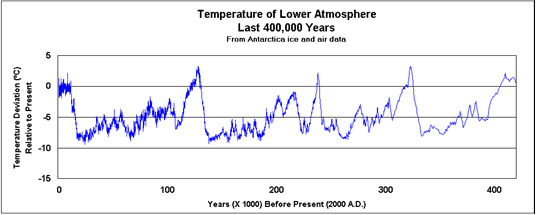
Long Term Cyclic Temperature Record –  The first essential is to understand the context of the current discussion with respect to the very long term and the extremely long term temperature record of the planet.  We all know about glaciers and how they advanced and retreated.  The last glacial period started about 110,000 years ago and ended about 15,000 years ago.   During that time period there were about 8 advances and retreats of the glaciers as the earth alternately cooled and heated within the last glacial period.   Now, looking at the very long term there are extended periods or cycles of warming followed by extended periods of cooling.  Figure 1 shows how those cycles look based on ice core data from Antarctica.  Note how the cooling trends last for a very long time and how the warming trends tend to shoot up rapidly (speaking in terms of geologic time).  Also note how the past 3 peaks were much sharper and higher than the current peak. The reason for this is not known.

Temp cycles

Figure 1 – Temperature changes over a period of 400,000 as derived from Antarctica ice core ( Note: similar data has been derived from ocean sediments)

Many people with knowledge of glaciation and of this long term cyclic record of the earth’s temperatures, which goes back 800,000 years, did and still do question the man caused global warming assertion promulgated by the United Nations Climate Committee in the late 1980’s.

Terminology –The second piece of basic information to understand is the relationship of the term Global Warming to the now popular but imprecise term “Climate Change” and the “non-obvious” implication of this term and, as an important detail, the ways the average global temperature is determined.

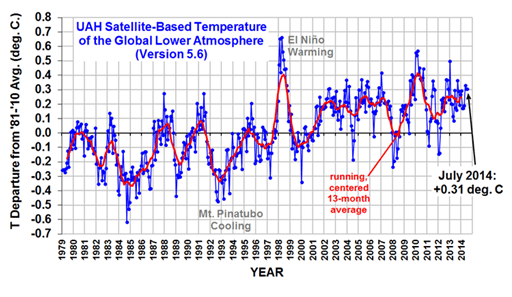
Global Warming means the year to year increase in the “average” global temperature. This “average” temperature is now measured in two ways.  (1) The first, and oldest, means of establishing this average is via a land – ocean array of sites. It is the one used in the NASA Global Temperature Index for Land & Ocean shown in Global Warming 101. (2) The second, is the average temperature of the lower troposphere (near surface layer) obtained from satellites passing over the array of measuring locations around the globe twice a day.  The satellite array (established in 1978) has the intended advantage of removing the effects of the “urban heat sinks” present in the land-ocean array.  The satellite data, are interpreted and published by two different groups that are referred to as RSS and UAH.  The UAH plot is by the University of Alabama at Huntsville and the RSS data is from Remote Sensing Systems (RSS), a scientific research company located in Northern California, specializing in satellite microwave remote sensing of the Earth.  Although the analysis techniques for interpretation of the data are different the results are quite similar.  Figure 2 shows the history of the average global temperature record since 1979 from the UAH source.  As in the land-ocean record there was a peak in 1998, however in the satellite data the peak was very sharp and since that time the satellite data show that that the 1998 average global temperature peak has not been exceeded.  That is why you will hear it reported that the “earth has been cooling for the last 18 years” and at the same time hear reports, (like President Obama’s statement in the 2014 State of the Union address), that 2014 was hottest year on record. Both statements were true, they are using different data sets.  According to the satellite data, 1998 is the hottest year on record, 2010 is next and then 2015.  According to the land-ocean data the 1998 temperature represented a local peak and since then the trend is slowly creeping upward, however there was a big increase in 2015 and that might be seen in 2016 as well as it is another El Nino year.

UAH 1979-2014

(1)     Figure 2 – Global temperatures from satellite data since 1979 (UAH_LT_1979 Through Dec 2014) A global temperature high (as measured from satellite data in the lower troposphere) was reached in 1998 and since that time (17 years and counting) global temperatures have been at or below that peak level.

Climate Change — This term is now used as a euphemism for “anthropogenic global warming” – i.e. global warming  being caused by humans.  The term appears to have been intentionally adopted as a means to focus attention on and engender concern about the recognized adverse physical effects of global warming – glaciers retreating, polar ice diminishing, and the range of plants and animals being impacted, and at the same time shrewdly imply or infer that the cause of these physical effects is human source CO2, as though the question was settled.  It is an imprecise term technically, that has obscured the real question of whether the current warming is “anthropogenic”, or is due to natural forces.  Use of the term effectively discredits, in the public eye, the many climatologists scientists and technical people who challenge the CO2 – anthropogenic global warming assertion.  This public media discrediting is easy because it infers that the “skeptics” or “deniers”  are arguing that the  “climate change” physical effects are not occurring and it makes them look totally unrealistic and out of touch.

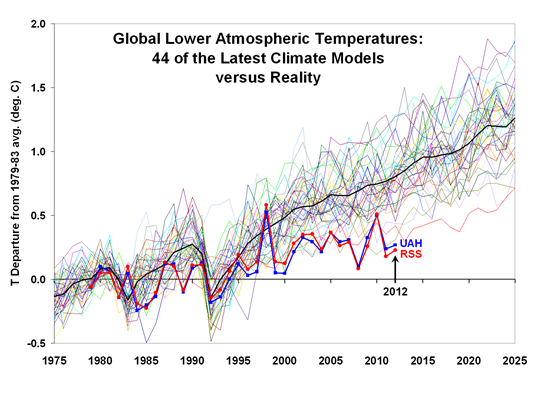
Climate Models – The United Nations established the International Panel on Climate Change (IPCC) in 1988. The IPCC was charged to obtain, scientific, technical and socioeconomic information relevant for the understanding of the risk of human-induced climate change.”  Notice that it appears that the IPCC was not charged with investigating the hypothesis of whether or not global warming was being influenced by human source CO2, but rather to start with that assumption and show the risks.   And as it turns out the IPCC is fulfilling their charge by conveying that there is considerable risk. The IPCC panel concluded in their first assessment report in 1990 that: anthropogenic climate change will persist for many centuries.   The IPCC funded an abundance of studies, resulting papers and climate models that supported their initial conclusion and a positive feedback loop developed that led to the IPCC’s subsequent assertion that human generated carbon dioxide emissions are the major cause of global warming.  The global warming models sponsored / paid for by the IPCC typically integrated or incorporated in their analytics a very adverse effect due to rising CO2 levels.  As can be seen in Figure 3, the models greatly overestimated the actual global warming that has occurred since 1998.   The results of these models were a primary rationale for the IPCC’s ominous warnings to the international community on the expected increases in global warming and associated adverse impacts (e.g. rising ocean levels).  These results were a prime driver of the global efforts to take action to reduce carbon dioxide emissions such as the Kyoto Protocol.  Now clearly seen as overestimates, IPCC models are still being used to justify warnings.   Note that although these models clearly appear to be inaccurate because of their emphasis on incorporating  assumptions about the dramatic effects of CO2, this is not to say that there will not be another sharp rise in global temperatures as there was post 1933 and post 1976.  The pattern of relative stable global temperatures since 1998 could well change in future years due to natural forces.

models vs actual temp

Figure 3- Climate models under IPCC auspices give projections of warming far exceeding the actual level of global warming as recorded post 1998 by the two official interpretations of the lower atmosphere temperatures based on satellite data (RSS – Remote Sensing Systems and UAH – University of Alabama at Huntsville).

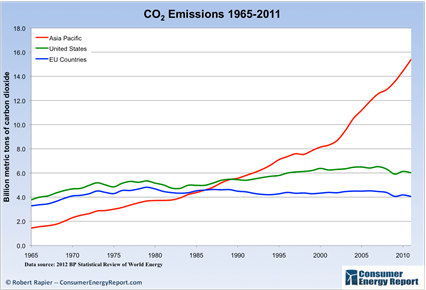
World Wide CO2 EmissionsThe fourth essential to be aware of is the worldwide distribution of CO2 emissions. For a variety of reasons US and European human source CO2 emissions have increased only marginally since 1965 and since about 2007 are declining (see Figure 4).   Emissions from Asia-Pacific countries (primarily China) have been greatly increasing, keeping the overall global human source CO2 emissions advancing at the steady, high rate observed in the graph presented in global warming 101.  This illustrates the  irrational efforts to restrict United States CO2 emissions to effect “climate change” when such restrictions, (1) are based only on theory and have no verifiable evidence of a positive effect, (2) are offset many fold by the emissions being produced by Asian countries, and  (3) can adversely impact the U. S. economy and people’s livelihoods.  The first point, that there is no demonstrable empirical evidence that CO2 restrictions can have a meaningful effect on reducing average global temperature appears to me to be irrefutable.  This is because CO2 emissions are on the rise and have been on the rise for more than a hundred years.  Thus, there has never been a sustained time period with reduced CO2 emissions to allow such evidence to be obtained.  Of course the fact that there has not been the chance to really test a global reduction in CO2 does not prove that it would not have an effect, it simply illustrates that such evidence is lacking.  Further, it does not preclude cutting CO2 based on a confident belief or hope that it would have a positive effect. However, evidence does exist that while human source CO2 emissions were increasing 4 fold over a period of 24 years (1944-1978), global temperatures decreased. Such evidence casts serious doubts about the efficacy of cutting CO2 to reduce global temperatures.   Regulations that would cut CO2 emissions would  make only a small reduction in the US contribution and as can be seen from the rate of rise in Asia Pacific emissions the US cuts would pale in comparison to the increases by the developing countries on which restrictions are not being placed.

CO2 rise around world

Figure 4 – Emissions of CO2 since 1965 – in the United States, Europe and the Asia Pacific

Based on what is known and can be observed from the historic temperature records, the long term trend of global warming will continue for an unknown time period. The trigger or triggers that have caused the global temperature cycles to reverse direction (see figure 1) are not known. Based on actual empirical evidence there is no reasonable expectation that reducing CO2 emissions will have any significant effect on global warming, even if it could be accomplished, which appears very unlikely based on the emissions of developing nations.

The bottom line is that global warming is continuing at an irregular pace and does not appear to be significantly influenced, positively or negatively, by human produced CO2 emissions based on empirical evidence.  Thus, with respect to global warming our nation’s efforts should be directed toward assessing and addressing the potential adverse impacts of global warming. The burning of fossil fuels should not be discounted as a problem but rather be addressed relative to the actual pollutants released by that activity.    Alternative energy sources should continue to be developed because it makes sense to do so.

Human caused global warming and the reduction of CO2 emissions to slow or reverse global warming were and still are hypotheses.  These hypotheses can be countered and shown to be doubtful using empirical data.   An impending, human induced “climate change” calamity continues to be presented to the American people and the world as if it were absolute reality, and as if something meaningful could be done to abate it.  There are apparently many in the scientific and technical community who belief this to be true. In future episodes we will examine the rationale for that belief.  There are many who simply accept that what most in the technical community believe must be true.  And there are some who use their belief in the “climate change” scenario for socio-political and personal economic purposes.  For my part, I see the empirical evidence painting a different picture.   I am trying to provide what I believe to be the factual information related to this subject. So many in the public eye talk about this topic but have no idea what the basic facts are.  I invite you to join Global Warming 103, where with this foundation of factual data as a base we will begin to trace the history of the rise of the global warming concerns and learn about the Al Gore’s “convenient omission” that led so many astray on a very important point.    Thanks, Larry Von Thun

Freedom of Religion – Episode 1 (concise)

Freedom of Religion in the United States (concise version)

This is the story of Freedom of Religion in the United States and its subsequent assault and attempt at subjugation by the concept of “Separation of Church and State”

The fundamental right of Religious Freedom and the imposition of the concept of the Separation of Church and State are embroiled in a constant struggle.  The latter concept as it was and is invoked in the conduct of our lives and in our society affairs is a misrepresentation, a lie, that spread throughout the nation before the truth got its boots on, and is now regarded by most as a factual truth. Paradoxically, neither the term, nor the concept of “Separation of Church and State” appears in the U.S. Constitution.  Yet, the overreaching, misguided and zealous invoking of the concept of Separation of Church and State as if it is the law of the land in our Constitution has effectively served to diminish the actual free exercise of religion specifically provided for in our Constitution’s Bill of Rights.

The first tenet in the Bill of Rights as stated in the First Amendment to the Constitution is that Congress shall make no law respecting an establishment of religion, or prohibiting the free exercise thereof.”  (“respecting” may be read as “pertaining to” or “with respect to”) 

Episode 1 Arrival of the Pilgrims and the Establishment of the Colonies

Religious intolerance before the founding of the United States was, with few exceptions, the norm throughout the early history of “civilized” people.  It was part and parcel of the subjugation of one people by another.  Religious observances by the conquered people were typically forbidden by the invading country, not to convert the conquered, but because of the threat it represented to their control.  This was not always the case.  The spread of Islam was religiously motivated.  The Romans on the other hand allowed occupied peoples to maintain their religious observances as long as they also “respected the Roman Gods” – the Jewish people, interestingly, were granted an exemption.

The “right” of freedom of religion in America had its origins in post-Reformation Europe. New Christian denominations such as the Moravians, French Huguenots, and the Puritans were persecuted and struggled against governmental “state” religion demands for universal acceptance.   These early religious freedom conflicts laid the historical groundwork for an individual’s right to freedom of religion ultimately guaranteed in America’s Bill of Rights.

But surprisingly Colonial America was not a land that blessed by religious freedom.   Yes, the Puritans (called Pilgrims) came to these shores so that they could freely practice their religion. But ironically it was woe to anyone who did not practice their faith.

Religious freedom in the original 13 Colonies – did not get off to a good start! For example laws passed by the Puritans in Massachusetts in 1644 required exile of Anabaptists, fined ship’s captains for bringing Quakers to Massachusetts and called for whipping and assigning to prison with hard labor any Quakers who gained entry to the colony.   The Connecticut “Code of 1650” had as its opening statement: “Whosoever shall worship a God other than the Lord shall be put to death”.

Although less extreme, lack of religious freedom was the norm in most other colonies.  The “state church” of England was carried over via the founding charters of the American colonies. Residents of a colony, by decree, were to be Anglican church members just as all English citizens were.  Nine of the thirteen original colonies had charters from England that established the Anglican church as thestate church” of the colony.

The most fertile seeds for the concept and adoption of “Christian” religious freedom in the 13 Colonies were planted in Rhode Island and in Pennsylvania.  Roger Williams who split from the Puritans, founded Rhode Island with some religious freedom protections. Even greater religious toleration was guaranteed in the Pennsylvania charter given to William Pitt, a Quaker. (The King granted that because he owed William Pitt’s uncle big time.)

That is kind of how things started in the colonies. State churches being funded by assessments on the population and fostering discriminatory practices. But with time and the influx of settlers from throughout Europe, with their varied Christian denominational backgrounds, religious diversity became infused into the population.  Further, the spirit of individualism and the rigorous pursuit of individuals and families to carve out a living, trumped the snobbish conventions required for societal acceptance. Thus, families and individuals in America were more likely to be respected and accepted for what they did rather than for where they came from or what they believed.

That brings us to the end of Episode 1 of “Freedom of Religion” in America.  But how did we come from this rocky start to gain our prized Freedom of Religion in the United States?  We will begin to find out in Episode 2 as we join the 13 “independent” Colonies beginning to think about banding together to collectively challenge, King George and Britain – the Mother Country over economic issues and the abuse of other rights of “Englishmen”. Log on to learn what happens in Freedom of Religion -Episode 2.

(note the above is the “concise” version of early colonial events for a more complete version see Episode 1- full version.)

Freedom of Religion Episode 2 (concise)

Freedom of Religion in America – Episode 2 (short version)

This is the story of Freedom of Religion in the United States and its subsequent assault and attempt at subjugation by the concept of “Separation of Church and State”

The fundamental right of Religious Freedom and the imposition of the concept of the Separation of Church and State are embroiled in a constant struggle.  The latter concept as it was and is invoked in the conduct of our lives and in our society affairs is a misrepresentation, a lie, that spread throughout the nation before the truth got its boots on, and is now regarded by most as a factual truth. Paradoxically, neither the term, nor the concept of “Separation of Church and State” appears in the U.S. Constitution.  Yet, the overreaching, misguided and zealous invoking of the concept of Separation of Church and State as if it is the law of the land in our Constitution has effectively served to diminish the actual free exercise of religion specifically provided for in our Constitution’s Bill of Rights.

The first tenet in the Bill of Rights as stated in the First Amendment to the Constitution is that Congress shall make no law respecting an establishment of religion, or prohibiting the free exercise thereof.”  (“respecting” may be read as “pertaining to” or “with respect to”) 

Episode 2 –Colonial Unification and Constitutional History Related to Freedom of Religion

As described in Episode 1 neither “freedom of religion” nor “Separation of Church and State” were in evidence in the early history of the 13 Colonies.  As the revolutionary period approached, “state churches” continued to exist in most of the colonies.  Although religious toleration existed in some regions, there was no organized effort to push this principle.  Commonly there were prejudicial actions against those who did not belong to the “state” sponsored church, e.g. membership in the “state church” was required to hold office. Each colony functioned relatively independently, and when the colonies did work together it  usually related to common defense, or an economic issue.  Because earning a living tended to occupy the people, religious toleration was “unofficially” practiced.

After the French and Indian War (1754-1763), the Colonists, who viewed themselves as British subjects, with the “rights” of British subjects, began complaining about taxation, quartering of British soldiers, etc. They considered England was restricting or retracting their rights.  Freedom of religion, however, was not one of the rights about which most Colonists were concerned.  Many were Anglican in the first place, and further they did not previously have a religious freedom “right” under the crown.  Religious freedom was not one of the root issues leading to the revolutionary war.  But several factors eventually drove religious freedom to the forefront of the Bill of Rights.

These factors included: (1) the necessity of the religiously disparate colonies to unite, (2) the common sense that recognized the diversity in Christian sects present among the states and within the total population had to be accommodated, (3) recognition of the incongruity of individual liberty and freedom for all and the dictating of a denomination by a colony, (4) the absence of any religious fervor or agenda among the founding fathers toward pushing for any particular Christian sect (and the “Anglican” denomination would certainly not be put forward in that role because of its ties to England), and (5) the religious freedom resolution which was put into the Virginia Constitution in which James Madison participated.

The 13 original colonies were not all that interested in uniting and giving up their “states rights”, not at the time before the Revolutionary War nor even afterward when the time came to prepare a Constitution and form a stronger central government.  However, it must have been evident to the Colonial leaders that:

  • there was no need for the central government, to establish a “state church”
  • it was not reasonable or realistic to establish a single Christian church denomination
  • such a requirement would have been against the cause of individual freedom.

Further at that time in history, Deism (believe in a Supreme Being but not the Christian Gospel) was common among many, including some founding fathers. Imposing a Christian Church upon the populous would not have been something that they would have personally supported.

Freedom of religion, while not a right given much attention with respect to the Revolutionary War, was a byproduct of winning it.  Anglicans and New England Congregationalists may not have even considered freedom of religion an issue (as they essentially had it all along). But there were likely a great number of Christians who recognized and rejoiced in the fact that there was no longer a “state church” and that freedom of religion would become a reality and an acknowledged fact.  The many Christian denominations in America who had been the receivers of religious intolerance would have been keenly interested in making religious freedom a documented fact in the new country and its constitution.  This interest was likely a major driving force behind the demand for a Bill of Rights.

One major exception to the ambivalence toward documenting religious liberty was in Virginia, which had an established Anglican “state” Church.  Virginia, was alive with the fervor of individual liberties, and one of those liberties that was being abridged was freedom of religion via the imposition of the Anglican Church.  So the Virginia patriots including James Madison, George Mason and Thomas Jefferson, urged the Virginia constitutional convention to pass “a declaration of the free exercise of religion” in their Constitution.   State aid to the Anglican Church was cut off and in 1786 Jefferson’s famous “Bill for Establishing Religious Freedom” passed. It stated “all men shall be free to profess, and by argument to maintain, their opinion in matters of religion”, and guaranteed Virginians that they would not be compelled to “support any religious worship place or ministry whatsoever”.  It took other states many years to include like language in their state constitutions.

The answer to the question of how and why “freedom of religion” become the first and one of the key rights, named in the Bill of Rights is now becoming a bit clearer.  But it is still three more years before “Freedom of Religion” becomes an integral part of our founding documents.

Most delegates to the Constitutional Convention in 1787 were “States Rights” delegates who came with the idea that the central government should be limited.  Thus, the focus of those preparing the Constitution was, that only the powers and responsibilities delegated to the central Government would be covered in the Constitution, everything else, anything that was not specifically identified, would remain with the states or with the people.  (This intent was later captured and still exists in the 10th amendment to the U.S. Constitution.)

Thus, it is not surprising, in light of the goal of only stating what the central government would do, that there was no consideration and no discussion of a “state church” or in fact anything to do with religion in the Constitution.   Thus, there was no administrative or legislative provision, nor any preference to be given to one church denomination over another by the Federal Government.  The Constitution assigned no powers and responsibilities to the central Government regarding religion.  There was no discussion of the concept or idea of the separation of church and state.  By silence on the matter it was clear that the past practice of a “state church” would not be the future practice. Churches and the Federal Government were viewed as distinct institutions.  But importantly, not as conflicting institutions.  Many of the founding fathers considered, just as the Pilgrims did, that the making of America was divinely inspired and divinely led.  James Madison, known as the father of the Constitution, when commenting on the Constitution, stated:  “We have staked the whole future of American civilization, not upon the power of government, far from it. We have staked the future of all of our political institutions upon the capacity of mankind of self-government; upon the capacity of each and all of us to govern ourselves, to control ourselves, to sustain ourselves according to the Ten Commandments of God.”   John Adams recognized the opportunity of the American Colonies to found a great democracy of the people as a gift from God and said we therefore “better get it right”.

So on September 17, 1787 the U.S. Constitution was sent to the states for ratification and it became the law of the land.  The Constitution did not establish a “State Church” and the Federal Government was granted no powers with respect to “governing” religion.  However, ratification came with requests from several states that specific rights of the people be spelled out.

That brings us to the end of Episode 2.  In Episode 3 we will learn how James Madison’s simply stated first sentence in the First Amendment of the Bill of Rights, “Congress shall make no law respecting an establishment of religion, or prohibiting the free exercise thereof.”, came to be. That statement, which is the only statement concerning religion or the church within the United States Constitution (as amended), provides the basis of a clear understanding of intent and we will see how that intent was implemented, respected and followed for the next 150 years.

(This version is somewhat abbreviated  – see episode 2 (full) for the complete version)

Global Warming 101

Global Warming 101 –Understanding the issue in two easy steps 

You hear claims that:

  • There is Global Warming!
  • That there has been no Global Warming for the last 17 years!
  • That Carbon Dioxide is largely responsible for the global warming now occurring!

What is true? – What are the facts?   

There are two key graphs that record what has occurred over more than a hundred years with respect to the rise in Global Temperatures and the increase in human source CO2.  These two graphs, shown and explained below, provide factual information that reveals what is really known and true about global warming and its empirical relationship to the increases in human source CO2.  

Introduction to the issue – After a sustained period of cooler global temperatures from 1944 to 1980 (see figure 1), the earth began to steadily warm again in accordance with the current long term warming trend (since 1650 and a matter of record since 1880, see Figure 2). As we moved into the late 1980’s the earth’s temperature was getting increasingly warm, reaching temperature levels nearing the high temperature peaks indicated in the earth’s previous cooling/warming cycles.   People were beginning to get concerned.   It was known that man made emissions of CO2 had been increasing rapidly (since about 1945) and it was known that CO2 in the atmosphere is a contributor (albeit a minor one) to keeping heat from escaping the earth.  Thus, it was reasonable to hypothesize that the large increase in CO2 emissions by human activities was increasing the rate of global warming.  This was a theory or hypothesis and like any hypothesis it needs to be examined, tested, and verified before it is accepted as fact.  So let us test the hypothesis!

Step 1 —The first, really important graph, is that of the average annual global temperature based on numerous land and ocean sites around the earth (Figure 1). This plot is the NASA Global Temperature Index for Land & Ocean and you can see it on their site – climate.nasa.gov/vital-signs/global-temperature. It shows the average global temperature value for each year (light red line) in degrees centigrade above or below the 0 reference line as well as a running 5 year mean (dark red line). The data extend back to 1880 and clearly show that there has been net global warming over the last hundred and thirty years. Therefore, that is a well-documented scientific fact! However, this graph also shows that that rate of warming has been irregular. If you look closely at the peaks and valleys of this record you will see something very interesting and very telling with regard to global warming and CO2.

Figure 1

Figure 1- NASA global temperature data plot – (NASA Headquarters release No. 12-020)

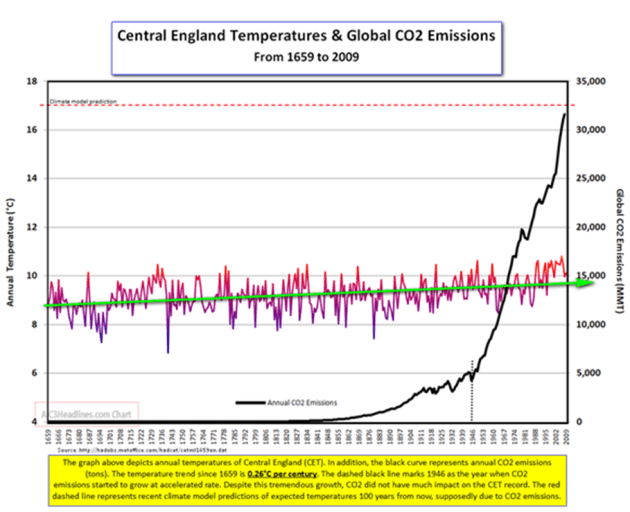
The year 1880 is when this record started and it happens to be around the time human source CO2 was beginning to increase. This can be seen on the second important graph (Figure 2). The Fig. 2 plot also indicates that the current warming cycle or trend extended back to 1659. (It happens that the estimated coldest year of the “Little Ice Age” was around 1650). Now, as promised, there is something very interesting when you look closely at the Figure 1 plot. You will see that the average global temperature for 1900 was not exceeded till the mid 1930’s. In fact, there was a net drop (global cooling) between 1900 and 1933 of 0.19 degrees C. Then temperatures began to rise rapidly and by 1944 the average global temperature had risen 0.53 deg. C in 11 years. Now look closely at Figure 1 again and you will see that after 1944, 25 years passed before the 1944 average global temperature was exceeded (global cooling again for 25 years). In fact, by the mid 1970’s there were scientists issuing “alarms” of an impending “ice age” and that forecast was being carried to the public in the newspapers. And why not, the global average temperature in 1976 was 0.37 Deg. C below that of 1944. Brrr was the word of the day. But just as in the 1900 to 1933 period, warming picked up again and between 1976 and 1998 (a peak el Nino year) the average global temperature rose by 0.74 deg. C. This yielded a net temp rise of 0.71 degrees C from 1900 to 1998.   So that that is roughly 0.7 degrees per century.

Step 2 – These average global temperature ups and downs are interesting but when they are juxtaposed in time with the record of CO2 increase they reveal much, much more!! So, look now at the graph of the rise of the global CO2 emissions on Fig.2. Note that the rate of increase in CO2 was fairly steady between 1880 and the mid 1940’s and then the rate increased greatly and has continued at that high rate to the present. This step involves examining what happened to average global temperatures for each of two periods (1880 -1944) and (1944 to 1998) and is critically important to showing whether CO2 influenced the temperature based solely on empirical evidence.

Figure 2

Figure 2 –  Warming trend in central England since 1659 vs. annual CO2 human source emissions – source Hadley Centre England

So if we look at the human source CO2 emission rate and absolute quantity of emissions at the beginning and end of each of the definable (warming and cooling) periods on the global temperature record one can note whether or not there is a correlation of CO2 increases to global warming increases. This turns out to be very easy. By inspection it can be seen that there was both a global temperature “cooling” period and “warming” period in each of the two time spans that had a relatively rate of increase in human source CO2 emissions. Thus, it is immediately clear, based on these data that there is not a direct correlation of human source CO2 rise and global temperature rise. To reinforce this point let’s examine in detail the period 1944 to 1976.

By 1944 global human source CO2 emissions had increased to 5,000 MMT (Million Metric Tons) from about 2,000 MMT in 1880. Figure 2 shows that between 1944 and 1976 CO2 emissions increased to 20,000 MMT. So the earth started in 1944 with CO2 emissions at 5000 MMT and over the next 22 years CO2 emissions increased to 20,000 MMT. The global temperature at the end of that period (1976) was 0.37 deg. C lower than at the start of the period in 1944. So despite a quadrupling of annual human source CO2 emissions during the period 1944-1976 global temperatures cooled by 0.37 degrees from the 1944 global temperature value to the 1976 global temperature value. Figure 3 provides a corroborating reference on the rise in CO2 since 1800, and it provides an estimate of the contributors.  The original data for the total shown is likely taken from the source shown in Figure 2.

In terms of absolute quantity of CO2 emissions, note that the average level of CO2 emissions over that 22 year period was 2.5 times the level of CO2 at the beginning of the period but there was no increase in global temperature during the period, in fact there was a net decrease. Juxtaposition of the rise of CO2 emissions and the global temperature change with time clearly shows that there is not a direct correlation in time between the two. This clearly contradicts the assertion of a direct correlation between CO2 emissions and global temperature rise, advanced and put forth by United Nations, promoted by the media and now pronounced by the President, and even the Pope. The confidence with which these latter, eminent proponents of cutting CO2 emissions is based on is the endorsement of the role of CO2 in global warming by the vast majority of scientists (as  shown by polls). However, the above factual, unaltered and simple portrayal of easy to obtain empirical data clearly shows that (1) global warming is continuing but does so at an irregular pace and (2) that global warming is not significantly influenced by increases in human source CO2 emissions. The corollaries to this conclusion are that cutting CO2 emissions will likewise not have effect on reducing global warming and that other factors control global temperatures, just as they have for millennia. Thus, efforts and expenditures should be directed toward addressing the potential adverse effects of global warming and not on efforts and expenditures on trying to reduce CO2 emissions. Further, reduction in fossil fuel use should be based on cutting the true pollution they produce and the need and value of the development of alternative energy sources.

Those are the bare facts that are essential to understanding the truth about global warming. That brings us to the end of 101, but there is much more to learn. Tune in to Global Warming 102 to learn a few more key facts to help you discern the validity of the abundance of comments and opinions expressed about global warming and the role of CO2.

 Figure 3

Figure 3 — global emissions Image from Wikipedia


Freedom of Religion Episode 2 (Full )

Freedom of Religion in America – Episode 2 (full version)

This is the story of Freedom of Religion in the United States and its subsequent assault and attempt at subjugation by the concept of “Separation of Church and State”

The fundamental right of Religious Freedom and the imposition of the concept of the Separation of Church and State are embroiled in a constant struggle.  The latter concept as it was and is invoked in the conduct of our lives and in our society affairs is a misrepresentation, a lie, that spread throughout the nation before the truth got its boots on, and is now regarded by most as a factual truth. Paradoxically, neither the term, nor the concept of “Separation of Church and State” appears in the U.S. Constitution.  Yet, the overreaching, misguided and zealous invoking of the concept of Separation of Church and State as if it is the law of the land in our Constitution has effectively served to diminish the actual free exercise of religion specifically provided for in our Constitution’s Bill of Rights.

The first tenet in the Bill of Rights as stated in the First Amendment to the Constitution is that Congress shall make no law respecting an establishment of religion, or prohibiting the free exercise thereof.”  (“respecting” may be read as “pertaining to” or “with respect to”) 

Colonial Unification and Constitutional History Related to Freedom of Religion

As described in Episode 1 neither “freedom of religion” nor the concept of or inclination toward  the “Separation of Church and State” were principles in the founding and early expansion of the 13 Colonies.  As the colonies grew over the next 100 years or so and the revolutionary period approached, “state churches” continued to exist in most of the colonies.  The concepts of freedom of religion and religious toleration arose or existed in some regions but there was no organized, concerted effort to extend or push this principle.  More commonly there were prejudicial actions and restrictions placed on individuals and groups who did not belong to the “state” sponsored church.  For example, typically membership in the “state church” was a requirement for holding office in the colony’s government. Each colony functioned relatively independently, and when the colonies did work together it was usually related to common defense, foreign policy, trade or some other economic issue.  And internally, within each colony, because there were more important or more pressing issues to occupy the consciousness of the populous, religious toleration was to a certain extent “unofficially” practiced.

However, the status quo of the Colonies, each to some degree under the thumb of the British King and Parliament, began to change after the French and Indian War (1754-1763).  The Colonists, viewing themselves as British subjects, considered they had the “rights” of British subjects.  Complaints concerning England’s governance of the Colonies arose (taxation, quartering of British soldiers, etc.) and the Colonists considered that the Mother Country was restricting or retracting their rights.  Freedom of religion, however, was not one of the rights about which most Colonists were concerned.  Many were Anglican in the first place, and they did not previously have a religious freedom right under the crown.  Further Britain was not actively involved in the religious affairs of their subjects in the American Colonies.   So religious freedom was not one of the root issues leading to the revolutionary war.  But as a practical matter there were several factors that eventually drove religious freedom to the forefront of the Bill of Rights.

These factors included: (1) the necessity of the religiously disparate colonies to unite, (2) the common sense that recognized the diversity in Christian sects present among the states and within the total population had to be accommodated, (3) recognition of the incongruity of individual liberty and freedom for all and the dictating of a religious belief by a state, (4) the absence of any religious fervor or agenda among the founding fathers toward pushing for any particular Christian sect (and the “Anglican” denomination would certainly not be put forward in that role because of its ties to England), and (5) the religious freedom resolution which was put into the Virginia Constitution in which James Madison participated.  Now let’s explore these factors.

The 13 original colonies were not all that interested in uniting and giving up their “states rights”, not at the time before the Revolutionary War nor even afterward when the time came to prepare a Constitution and form a stronger central government.  However, it must have been evident to the Colonial leaders, like Franklin,  Adams, Washington, Jay, Hamilton and Madison who worked to unite the Colonies, first via the Committees of Correspondence, then under the Articles of Confederation, and finally under the U.S.  Constitution for the governing of the United States, that:

  • there was no need for the individual states, much less the central government, to establish a “state church”
  • it was not reasonable or realistic to establish a single Christian church denomination to which each of the States would be required to adopt and all the people would be required to belong
  • such a requirement would have been antithetical to the cause of individual freedom.

Further at that time in history, Deism (believe in a Supreme Being but not the Christian Gospel) had become common among many, including some of the most influential founding fathers (writers of the constitution).  As a rule deists continued to attend church services (Anglican,  Puritan, Universalist, etc. ) throughout their lives, as it was important in maintaining their social standing.  However, imposing a state church upon the populous would not have been something that all of them would have personally supported.

Thus, upon winning independence from Britain and becoming united Colonies, the freedoms that the colonists had specifically fought for and won became reality.  Freedom of religion, while not a right given much attention with respect to the Revolutionary War, was a byproduct of it.  While a large number of Anglicans and New England Congregationalists may not have even considered freedom of religion an issue (as they essentially had it all along), there were likely a great number of people who recognized and rejoiced in the fact that there was no longer a “state church” and that freedom of religion would become a reality and an acknowledged fact.  The numerous Christian people whose denominations in America had been the receivers of religious intolerance would have been keenly interested in making religious freedom a documented fact in the new country and its constitution.   The need to acknowledge this fact may have been one of the major driving forces behind the need for the Bill of Rights.

One major exception to the general state of ambivalence of the liberated Colonists attention toward documenting religious liberty was in the colony of Virginia. Recall Virginia was one of the colonies that had an established Anglican “state” Church.    Virginia, was alive with the fervor of individual liberties, and one of those liberties that was being abridged was freedom of religion via the imposition of the Anglican Church.  So, not withstanding that the Anglican Church was the church home of most of the prominent Virginia revolutionaries and statesmen who had sought liberty, it was even more so the home church of the British loyalists with whom they had contended.  The patriot revolutionaries including James Madison, George Mason and Thomas Jefferson, who were representatives to the Virginia constitutional convention did not like the idea of the imposition of the requirement for a “state” Anglican Church in Virginia and supported and obtained “a declaration of the free exercise of religion” in their Constitution.   Three years later, state aid to the Anglican Church was cut off and in 1786 (just before the United States Constitutional Convention in 1787) Jefferson’s famous “Bill for Establishing Religious Freedom” was passed by both houses of the state legislature.  This bill stated “all men shall be free to profess, and by argument to maintain, their opinion in matters of religion”, and guaranteed Virginians that they would not be compelled to “support any religious worship place or ministry whatsoever”.  It took other states many years to include like language in their state constitutions.

The answer to the question of how and why “freedom of religion” become the first and one of the key rights, named in the Bill of Rights despite it not being a key issue driving the Revolution War is now becoming a bit clearer.  But it is still three more years before “Freedom of Religion” becomes an integral part of our founding documents.

As indicated above, at the time the Constitution was being written, maintaining States Rights was the prevailing mentality among the delegates.  Most delegates to the Constitutional Convention in 1787 represented their states with the idea that the central government should be limited.  Thus, the intent and focus of those preparing the Constitution was, that only the powers and responsibilities delegated to the central Government would be covered in the Constitution, everything else, anything that was not specifically identified, would remain with the states or with the people.  (This intent was later captured and still exists in the 10th amendment to the U.S. Constitution.)

Because of the limited delegation of powers intent and focus, James Madison, the prime mover of the Constitution, and other delegates did not consider it necessary for the Constitution to spell out those powers / rights that were not given to the Central Government.  Thus, it is not surprising, especially in light of the discussion above, that there was no consideration and no discussion of a “state church” or in fact anything to do with religion in the Constitution.   There was to be no coercive power, no legislative influence, and no preference to be given to one church denomination over another by the Federal Government.  The Constitution assigned no powers and responsibilities to the central Government regarding religion.  There was no discussion of the concept or idea of the separation of church and state.    By silence on the matter it was clear that the past practice of a “state church” would not be the future practice and thus the Federal Government would not be establishing a “preferred” state sponsored denomination.   Churches (and their status in various states) and the Federal Government were recognized and accepted as distinct institutions.  But importantly, not as conflicting institutions.  Many of the founding fathers considered, just as the Pilgrims did, that the making of America was divinely inspired and divinely led.  James Madison, known as the father of the Constitution, when commenting on the Constitution, stated:  “We have staked the whole future of American civilization, not upon the power of government, far from it. We have staked the future of all of our political institutions upon the capacity of mankind of self-government; upon the capacity of each and all of us to govern ourselves, to control ourselves, to sustain ourselves according to the Ten Commandments of God.”   John Adams recognized the opportunity of the American Colonies to found a great democracy of the people as a gift from God and said we therefore “better get it right”.

So on September 17, 1787 the U.S. Constitution was completed and sent to the states for ratification and on June 21, 1788 it was ratified by the 9th state and became the law of the land.  The key aspect of the Constitution with respect to religion was that there would be no “State Church” and in fact the Federal Government was granted no powers with respect to “governing” religion.  However, ratification came with requests from several states that specific rights of the people be spelled out.

That brings us to the end of Episode 2.  In Episode 3 we will learn how James Madison’s simply stated first sentence in the First Amendment of the Bill of Rights, “Congress shall make no law respecting an establishment of religion, or prohibiting the free exercise thereof.”, came to be. That statement, which is the only statement concerning religion or the church within the United States Constitution (as amended), provides the basis of a clear understanding of intent and we will see how that intent was implemented, respected and followed for the next 150 years.

Truth has its boots on!

The title of this blog is derived from the saying: ‘A lie will go round the world while truth is pulling its boots on.’   This saying was attributed (in 1919) to Mark Twain. However, a quick search shows that there are numerous variations on this “proverb” that go all the back to 1710. In 1840 Thomas Jefferson was credited with saying: “falsehood will travel over the country, while truth is pulling on its boots”, and in an 1855 sermon, Charles Spurgeon a London preacher said, “If you want truth to go round the world you must hire an express train to pull it; but if you want a lie to go round the world, it will fly; it is as light as a feather, and a breath will carry it. It is well said in the old Proverb, ‘A lie will go round the world while truth is pulling its boots on.’

Regardless of the origin, the reality of this premise has been observed by many. I have witnessed this phenomenon numerous times, including several instances just in the last few years. Misconceptions, misunderstandings, falsehoods, and downright intentional lies are spread rapidly by several means and there a number of reasons why that happens. Acceptance, based on emotion and misplaced trust in the source, rather than on rational study and evaluation, is the root cause. A misconception or lie can spread due to fear, excitement, worry, gossip, or misrepresentation (intentional or unintentional). Once it is individually or globally endorsed or accepted the false narrative becomes “conventional wisdom”. Overturning the error and correcting a falsely imbedded impression is a challenge but it can and has been done, but not necessarily with 100% success.

For example, in the 1700 hundreds a false narrative was spread that blacks were intellectually inferior to whites and that “fact” became well known and well accepted. It took a long time for that assertion to be recognized by almost everyone as invalid. In the last century in the United States the “idea” of separation of Church and State, has supplanted the actual, documented “first amendment right to free exercise of religion”. This misconception has via judicial autocracy and “conventional wisdom” become an accepted fact by the greater part of the populous.

My goal in the missives of this blog is to set the record straight – to put the boots on the truth and get it out !    Complex topics, where history and details are important will come in short installments.   Hopefully, each installment of these more complex topics will put you on the edge of your seat – eager for the next episode.

Getting and verifying the facts surrounding a topic leads down many roads and often those roads are filled with interesting information that I yearn to share – but may make the story too long.  Thus,  I have attempted to provide two choices on some of the topics – a more concise version for those who like that and a “full” version for those wanting more detail.  Thanks for joining with me in this effort to PUT THE BOOTS ON THE Truth!!  Larry Von Thun

Freedom of Religion -Episode 1 (Full)

Freedom of Religion in the United States

This is the story of Freedom of Religion in the United States and its subsequent assault and attempt at subjugation by the concept of “Separation of Church and State”

The fundamental right of Religious Freedom and the imposition of the concept of the Separation of Church and State are embroiled in a constant struggle.  The latter concept as it was and is invoked in the conduct of our lives and in our society affairs is a misrepresentation, a lie, that spread throughout the nation before the truth got its boots on, and is now regarded by most as a factual truth. Paradoxically, neither the term, nor the concept of “Separation of Church and State” appears in the U.S. Constitution.  Yet, the overreaching, misguided and zealous invoking of the concept of Separation of Church and State as if it is the law of the land in our Constitution has effectively served to diminish the actual free exercise of religion specifically provided for in our Constitution’s Bill of Rights.

The first tenet in the Bill of Rights as stated in the First Amendment to the Constitution is that Congress shall make no law respecting an establishment of religion, or prohibiting the free exercise thereof.”  (“respecting” may be read as “pertaining to” or “with respect to”) 

Episode 1 Arrival of the Pilgrims and the Establishment of the Colonies

Religious intolerance before the founding of the United States was, with few exceptions, the norm throughout the early history of “civilized” people.  It was part and parcel of the subjugation of one people by another.  Religious observances by the conquered people were typically forbidden by the invading country, not to convert the conquered, but because of the threat it represented to their control.  This was not always the case.  The spread of Islam was religiously motivated.  The Romans on the other hand allowed occupied peoples to maintain their religious observances as long as they also “respected the Roman Gods” – the Jewish people, interestingly, were granted an exemption.

The “right” of freedom of religion in America had its origins in post-Reformation Europe. New Christian denominations such as the Moravians, French Huguenots, and the Puritans were persecuted and struggled against governmental “state” religion demands for universal acceptance.   These early religious freedom conflicts laid the historical groundwork for an individual’s right to freedom of religion ultimately guaranteed in America’s Bill of Rights.

But surprisingly Colonial America was not a land that blessed by religious freedom.   Yes, the Puritans (called Pilgrims) came to these shores so that they could freely practice their religion. But ironically it was woe to anyone who did not practice their faith.

Religious freedom in the original 13 Colonies – did not get off to a good start! For example laws passed by the Puritans in Massachusetts in 1644 required exile of Anabaptists, fined ship’s captains for bringing Quakers to Massachusetts and called for whipping and assigning to prison with hard labor any Quakers who gained entry to the colony.   The Connecticut “Code of 1650” had as its opening statement: “Whosoever shall worship a God other than the Lord shall be put to death”.

Although less extreme, lack of religious freedom was the norm in most other colonies.  The “state church” of England was carried over via the founding charters of the American colonies. Residents of a colony, by decree, were to be Anglican church members just as all English citizens were.  Nine of the thirteen original colonies had charters from England that established the Anglican church as thestate church” of the colony.

The most fertile seeds for the concept and adoption of “Christian” religious freedom in the 13 Colonies were planted in Rhode Island and in Pennsylvania.  Roger Williams who spilt from the Puritans, founded Rhode Island with some religious freedom protections. Even greater religious toleration was guaranteed in the Pennsylvania charter given to William Pitt, a Quaker. (The King granted that because he owed William Pitt’s uncle big time.)

That is kind of how things started in the colonies. State churches being funded by assessments on the population and fostering discriminatory practices. But with time and the influx of settlers from throughout Europe, with their varied Christian denominational backgrounds, religious diversity became infused into the population.  Further, the spirit of individualism and the rigorous pursuit of individuals and families to carve out a living, trumped the snobbish conventions required for societal acceptance. Thus, families and individuals in America were more likely to be respected and accepted for what they did rather than for where they came from or what they believed.

That brings us to the end of Episode 1 of “Freedom of Religion” in America.  But how did we come from this rocky start to gain our prized Freedom of Religion in the United States?  We will begin to find out in Episode 2 as we join the 13 “independent” Colonies beginning to think about banding together to collectively challenge, King George and Britain – the Mother Country over economic issues and the abuse of other rights of “Englishmen”. Log on to learn what happens in Freedom of Religion -Episode 2.

(note the above is the “concise” version of early colonial events for a more complete version see Episode 1- full version.)                                                

Episode 1 (full version) Arrival of the Pilgrims and the Establishment of the Colonies

Religious intolerance before the founding of the United States was, with few exceptions, the norm throughout the early history of “civilized” people.  Religious intolerance was typically integrally related to the political and military subjugation of one people by another empire or country.  Religious observances by the conquered people were often forbidden or abolished by the conquering country because of the political threat they could present to the control of the country and not because of a desire to “convert” the conquered.  This was not always the case.  The spread of Islam was religiously motivated as well as politically motivated.  The conquered peoples were generally forced to follow the religion of their conquerors.  The Romans on the other hand allowed concurred peoples to maintain their religious observances as long as they also “respected the Roman Gods” – the Jewish people, however, were granted an exemption. Another unusual exception was Akbar (a Muslim ruler) who allowed the Hindus in India to maintain their religious worship. He found this was advantageous in keeping his empire peaceful.

However, more germane to the consideration of the “right” of freedom of religion in America were the internal events in countries in Europe following the Reformation.   There were struggles against religious persecution and the freedom to practice a religion by many Christian sects.  The Moravians struggled against counter reformation governments in Eastern Europe, the Huguenots were persecuted by the Catholic French Government, the Irish Catholics struggled against England, and of course the Puritans had to escape the dictates of Anglican State Church of England.  All of these struggles helped develop the concept of the individual’s right to freedom of religion and to a degree helped ensure that “freedom of religion” was a right that came to be included in America’s Bill of Rights.  However, a common misconception is that Colonial America was a land that promoted and supported “Freedom of Religion”.  The Puritans (called Pilgrims) came to the unsettled American shores so that they could freely practice their religion but they did not endorse the concept of “freedom of religion”.  The Puritans escaped their religious persecution but they did not allow “freedom of religion” in their new lands.

Founding of the 13 Colonies    –   One of our most prized freedoms in the United States is the Freedom of Religion.  How did we come to have that freedom?   A common misunderstanding, based on the well known flight of the Puritans (Pilgrims) to avoid religious persecution in England, is that religious freedom was present here in America from the outset and that its incorporation in the Bill of Rights was just a formal recognition of its long term existence.   Well, surprise!!  The Pilgrims (who actually were of the Puritan religious sect) did not support religious toleration at all, much less religious freedom.   Laws were passed by the Puritans in Massachusetts in 1644 which required exile of Anabaptists and laws were passed which fined ship’s captains for bringing in Quakers to Massachusetts and for whipping and assigning to prison with hard labor any Quakers who managed to gain entry to the colony.  The New England Puritan settlers had very strict laws in their communities requiring adherence to religious and moral precepts of their sect.  Fines or harsh punishments were invoked for not attending church.  The “Code of 1650” established by the colony of Connecticut had as its opening statement: “Whosoever shall worship a God other than the Lord shall be put to death”

The colonists also certainly did not foster the concept of separation of church and state as evidenced in the “immediate act” they passed to govern themselves, which stated:  “We the undersigned, who for the glory of God, the advancement of the Christian faith and the honor of our native land have undertaken to found the first colony on these remote shores, do agree in this document, by solemn and mutual consent before God, to band together in a body politic in order to govern ourselves ——-.”  Everything the early Puritan settlers did centered on their religious beliefs.

Although the details were different and less extreme, the same lack of religious freedom and religious toleration was the norm in most of the other colonies.  The concept of “state churches” or “established” churches was transplanted to many of the American colonies from Europe, where many countries (France, Russia, Greece, Germany, Spain, etc.) had state churches at one time.  The governments of these countries financially supported, legislated for and protected these “state churches”.  Citizens of these countries were born into church membership just as they were born into citizenship.  Nine of the thirteen original colonies carried over this concept by way of their charters form England and thus had “established state churches” during the colonial period.

Most of the original colonies were “Crown Colonies”, that is colonies authorized under the auspices of the King of England.  England at this period in history was Anglican (Church of England  also now referred to as Episcopalian) and thus the official “state church” of these colonies (including 5 southern colonies) was established by charter as Anglican.  Those people who arrived in the colonies and did not practice the “state religion” suffered prejudice, persecution, and discredit.  Basically they were regarded as second class citizens.

Even the colony of Maryland, often thought of as a haven for Roman Catholics within the Colonies, as it was founded by Roman Catholics (the Calverts), was chartered as an Anglican colony.   Catholics although prevalent were denied the right to vote.  Even an Act that sounded good and for which Maryland has been recognized as a leader in religious toleration, the “Maryland Toleration Act” passed by the protestant majority legislature in 1649 was not very progressive with regard to religious freedom.  That Act allowed other religious groups to exist and worship in the colony but retained the Colonies right to withdraw or limit that permission, which it did.  “From 1654 to 1661 and from 1692 to the end of the Revolutionary period, Maryland, in fact nullified its Toleration Act.”

The most fertile seeds for the concept and adoption of “Christian” religious freedom in America were planted in Rhode Island and in Pennsylvania.  Roger Williams, a puritan minister, upon arrival in Boston in 1631, began zealous pursuit of “purifying” the Puritans from association with the King of England and the charters under which they operated.  Puritans were called and were by definition, “Separatists”, as they had separated themselves in England from the Anglican “state church”.    Williams, however, felt that the charter under which these colonists operated violated the Separatist ideal and he continually ran afoul of the neophyte Puritan religious and Civil establishment, including the Plymouth Colony where he initially was favorably received and assisted in ministry.  In addition to separatism he began to speak out for individual religious freedom.  He believed that civil magistrates should not have the authority to punish citizens for “Sabbath-breaking, false worship, and blasphemy, and that every individual should be free to follow his own convictions in religious matters”.  After 5 years, in 1636, he left Massachusetts and founded the Providence Plantation (Rhode Island) which guaranteed freedom of belief  (in a Christian sect) to all, (except outspoken atheists and Roman Catholics).   Later Roman Catholics were permitted in his Rhode Island Colony.   In 1651 England claimed the right to “govern” Rhode Island and in 1663 granted a charter to the Rhode Island and Providence Plantations which acknowledged Rhode Island’s religious freedom practices.

Unlike Rhode Island’s religious tolerance “experiment” developing out of conflict over a civil principle (granting of charters), the Pennsylvania colony was expressly formed to allow freedom of religion.   Pennsylvania was established as a “land grant” colony to satisfy a debt owed by the King of England to William Pitt’s father, not as a “crown” colony.  Thus, Pitt’s objective to create a colony that allowed for freedom of religion (due to his desire to protect himself and fellow Quakers from persecution) was able to be achieved free of the Anglican “state church” requirement.  As a result Pennsylvania became the seat of religious toleration (of Christian sects) within the colonies, welcoming the entire spectrum of sects and mainline Christian churches, from Moravians to Roman Catholics.

Despite the “official state church” concept carried over from England and pervading most of the American colonies,  the influx of settlers from throughout Europe with their varied religious backgrounds infused religious diversity into the population throughout the colonies.  Further the spirit of individualism and the rigorous pursuit of individuals and families to carve out a living, trumped the snobbish “European conventions” required for societal acceptance. Thus, families and individuals in America were more likely to be respected and accepted for what they did rather than for where they came from or what they believed.

That brings us to the end of Episode 1 of “Freedom of Religion”.  Episode 2 picks up as the 13 “independent” Colonies began to think about joining together to collectively challenge, King George and Britain – the Mother Country over economic issues and the abuse of other rights of  “Englishmen”. Tune in or log on to learn what happens in Episode 2.